
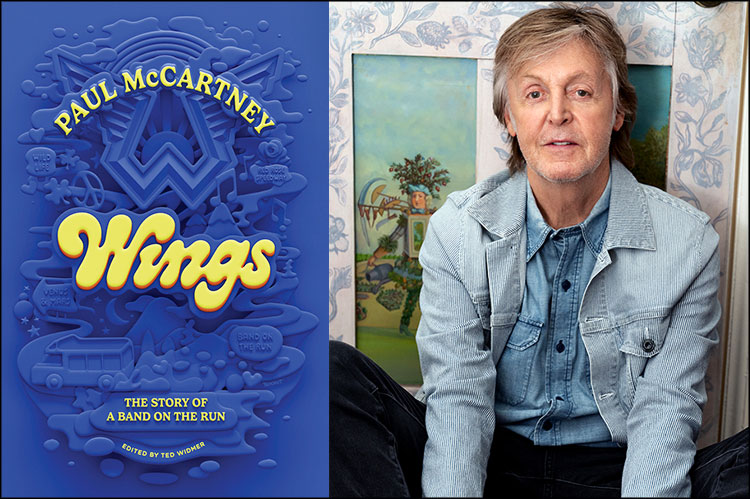
“Wings: The Story of a Band on the Run”
Paul McCartney
With Ted Widmer, Editor
Liveright, $45
Nearing the youthful age of 84, Paul McCartney has hardly let up. A workaholic — though you don’t “work” music, you play it, he notes — over 64 years he has produced a dozen albums and almost twice as many singles with the Beatles, a plethora of electronic, experimental, classical, and soundtrack releases, and more than two dozen albums as a solo artist or with his post-Beatles band, Wings.
In 2025, during his ninth decade, McCartney performed a three-night series of concerts at the intimate Bowery Ballroom in Manhattan and on the “Saturday Night Live 50th Anniversary Special,” attended a screening of “Man on the Run,” a documentary about his first decade after the Beatles (it is now available on Amazon Prime Video), and completed a 19-concert leg of his ongoing “Got Back” tour in the United States and Canada.
Amid those highlights, the longtime, part-time resident of East Hampton Town took in Metallica’s exhilarating performance under a tent behind the Stephen Talkhouse in Amagansett during an annual summer stay. And in November came a new book, “Wings: The Story of a Band on the Run,” and a companion compilation album, titled simply “Wings.”
“More times than I can count, I’ve been asked to write an autobiography, but the time has never been right,” McCartney wrote in “The Lyrics: 1956 to the Present,” issued in 2021. While that tome is perhaps autobiography-adjacent, featuring personal recollections, photographs, lyric sheets, and handwritten lyrics, notes, and drawings, those clamoring for something closer to memoir will find “Wings” a far more satisfying read.
An oral history, “Wings” digs deep into the 1970s, a decade bookended first by the Beatles’ dissolution and then that of his next band. In between is a story of resurrection and triumph, as McCartney builds an act worthy of following the Beatles, and, finally, tragedy, the new decade quickly and irrevocably defiled with the murder of John Lennon in December 1980.

Like Lennon, McCartney married in 1969, as the Beatles headed for divorce. His long partnership with the former Linda Eastman, who died in 1998, would inform and impact Wings in myriad ways. An inexperienced musician, she nonetheless was a charter member of the band, and in “Wings” draws high praise from some of her bandmates. But the influence of the family they created was also sizable, the children accompanying the band (of hippies) on tour and encouraging a long hiatus from the road as they grew older.
“The bandmates were getting older, and so were Paul and Linda’s children, now going to school,” the book’s final chapter begins. “Paul and Linda always wanted to be near them, and after moving the family to Sussex, they were that much further removed from the constant churn of the music business.”
Mary and Stella McCartney, the couple’s daughters, offer their recollections of life with Wings, along with band members including the late guitarist Denny Laine, the drummers Denny Seiwell, Joe English, and Steve Holley, and the guitarist Laurence Juber. Many other voices tell the story, including McCartney’s fellow Beatles, sound engineers and producers, musicians, journalists, and, crucially, Sean Ono Lennon, Lennon and Yoko Ono’s son, who, despite being too young to have experienced Wings, offers some of the book’s most insightful observations of McCartney and his singular genius.
In short, McCartney, distraught, retreated to his farm in remote Scotland as the Beatles imploded in 1969, and from there rebuilt, first with a solo album, “McCartney,” then “Ram,” credited to himself and his wife. Then, with Linda, Laine, the late guitarist Henry McCullough, and Seiwell, the drummer hired to play on “Ram,” Wings was born.
“It was weird starting all over again,” McCartney recalls. “But it wasn’t the world’s worst thing. It was sobering. It’s good to be knocked off your perch, to get your feet on the ground. There was a lot of that with Wings. Not only was I doing things for myself with the band, I was personally doing a lot of things for myself, living up in Scotland, mowing the field with my tractor.”
“It started to get really nice,” he writes, “and we started to feel very free. I started making music again, because I had my guitar with me and I had a piano. And I built a little studio.”
The critics were merciless, and McCartney was stung by dismissive if not condemnatory reviews of his early efforts. But in adversity comes greatness: On the eve of the sessions that would produce Wings’ breakthrough, 1973’s “Band on the Run,” Seiwell and McCullough quit, and the McCartneys and Laine chose Lagos, Nigeria, to record the album, their stay marked both by technical challenges and one or two near-death experiences.
The vacancies would be filled by English on drums and the late, hard-partying Scottish guitarist Jimmy McCulloch, and the band would produce the hit albums “Venus and Mars” (1975) and “Wings at the Speed of Sound” (1976), along with a 13-month “Wings Over the World” tour.
“We’ve done it,” McCartney remembers observing. “We’ve done what we set out to do. Nineteen seventy-six, we toured, and there we are in the biggest venues in America. These huge stadia, and people are loving it, and we’re putting on a show.”
“McCartney Comes Back,” Time magazine bellowed on a 1976 cover amid his new band’s 31-date American tour.

The band continued, though later albums were received less fondly, and a 1980 tour of Japan was canceled due to McCartney’s imprisonment, upon arrival, for marijuana possession. In “Wings,” he offers a more detailed narrative of the traumatic experience than has been previously disclosed, and with it reveals his enduring affinity for the psychoactive drug to which he and his fellow Beatles had been introduced, by Bob Dylan, in 1964.
“I was out in New York and I had all this really good grass,” McCartney recalls. “This stuff was too good to flush down the toilet. So I thought I’d take it with me. I was so warned against doing it. But I thought, ‘What the hell?’ . . . In my mind, I was only doing what everybody else was doing.”
By then, “the enthusiasm had peaked,” he says of a livelihood that had effectively begun at age 15, when he saw Lennon’s band, the Quarrymen, perform at a church fair. He issued a second solo album in 1980, months before Lennon’s murder. Wings officially ended with Laine’s departure in April 1981, and the following year McCartney would issue a masterpiece, “Tug of War,” featuring Laine on guitars but largely another solo effort.
Wings was of its time, and “The Story of a Band on the Run” gathers its participants and observers to chronicle a creatively fertile, happy-go-lucky period that from our troubled present’s perspective seems closer to fairy tale than history. As its protagonist reflects, “We made what seemed like an impossible dream come true.”