
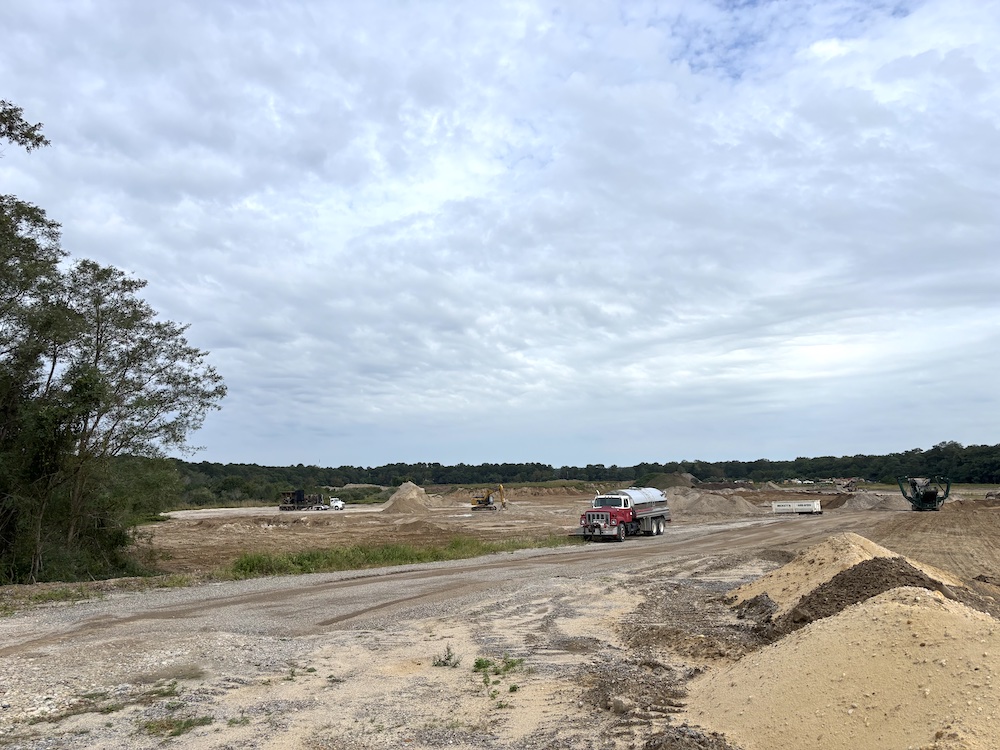
East Hampton Town wants to buy 38.3 acres of the Wainscott Commercial Center, the 70.5-acre former sand mine at 104 Wainscott Northwest Road, just north of the 7-Eleven gas station in Wainscott, and it’s willing to spend over $36 million to do it.
More than 80 percent of the property — 33.3 acres — would be used for parks and recreation and open space purposes, with five acres set aside for “municipal purposes,” according to the public hearing notice the town board approved last Thursday.
The hearing is scheduled for next Thursday at 6 p.m.
To complete the purchase, the town’s management and stewardship plan for community preservation fund properties will also need to be amended.
To get to the $36.3 million, which represents the second largest dollar amount the town will have spent on a parcel (it dropped $56 million for 30 acres on Wainscott’s Main Street in late 2024), the town is set to use a combination of community preservation funds (86.95 percent) for the open space portion and bonds (13.05 percent) for the five-acre municipal portion.
“A specific use for those five acres has not yet been determined,” according to a press release from the town. When pressed, Patrick Derenze, the public information officer, wouldn’t comment on whether housing was being considered.
The whole lot is currently zoned for commercial-industrial use.
“What I find especially meaningful about this property is the opportunity to take land that was mined and used for industrial purposes for many years and turn it into something that can really serve the community,” said Town Supervisor Kathee Burke-Gonzalez. “Most of it can become open space and recreation land, and the municipal portion gives us an opportunity to think carefully about what the town may need in the future. There is a lot of possibility here, and I’m excited about what this property can become for the community.”
This week the land was being regraded and then leveled with soil.
“You could create a native Long Island grassland, which are highly endangered,” said Abby Clough Lawless, owner of Farm Landscape Design, and designer of the Town Hall meadow.
The Long Island Native Plant Initiative collects seeds that could be used for such a project.
“It could be tremendous,” Ms. Lawless said. “I’m betting panicum and bluestem would love the sand pit.”
Edwina von Gal, executive director of the Perfect Earth Project, said her organization works with the Peconic Land Trust on the Georgica Pond Preserve just across the street. “It’s a restored Long Island grassland,” she said. “That can act as the visual inspiration.”
Plans for the parcel have long been controversial. Its location — at the heart of Wainscott’s commercial area north of Montauk Highway, just a couple of hundred feet from the headwaters of Georgica Pond, and at the gateway to East Hampton Town — means many eyes and interests will be focused on future plans for its development.
John Tintle, who controls the property through his Wainscott Hamlet Center L.L.C. and Wainscott Commercial Center L.L.C., is holding onto 19 acres that border the train tracks on the north end of the property. Riverhead Building Supply now owns 13 acres along the southeastern portion, where it has operated a masonry yard since last October.
It took years for the property to work its way through the town’s boards with a plan called the Wainscott Commercial Center, the largest commercial subdivision ever to come before the planning board, that would have seen the parcel divided into 50 commercial-industrial lots, each about an acre.
In 2023, the public panned the project at a hearing that lasted eight hours and had to be broken into two parts.
A 2019 East Hampton Town hamlet report on Wainscott, first commissioned in 2016, is sure to be exhumed and discussed at length as plans crystallize for the former sand pit.
At the time, community suggestions for redevelopment of the parcel included a shared parking lot, modest affordable housing development, green space for passive enjoyment, active recreation, a home improvement business area, a solar farm, an electric car charging station, a bus stop for the Hampton Jitney, and a future Wainscott train station.
“As one of the largest remaining tracts of land in East Hampton, the magnitude of potential environmental impacts stemming from redevelopment of the site is significant,” read the hamlet report. “At a minimum, the preparation of a detailed environmental impact statement will be required as a prerequisite for approval of a reuse or master plan. This should address physical changes to the land, impairments to Georgica Pond, impacts to on-site surface water and groundwater resources, impacts to drainage patterns and surface water runoff, impacts on air (during earth moving and construction), and impacts on fish and wildlife habitats within the watershed.”
Councilman David Lys, who is also liaison to the community preservation fund committee, took a long view this week.
“Through a collaboration of the town board, the property owner, and residents, this property can eventually become a focal point for the hamlet that won’t include heavy industrial uses on this portion of the property,” he wrote in a text.
“In using municipal funding sources for a portion, it’s a great advancement for a long-term look of the hamlet studies for this area. It is sure to produce many individual opinions about what could be done, but those discussions will continue going on over the years and will most likely be up to a future administration to design and determine what’s best for the area.”
—
Note: This story has been updated since it first appeared online.


