
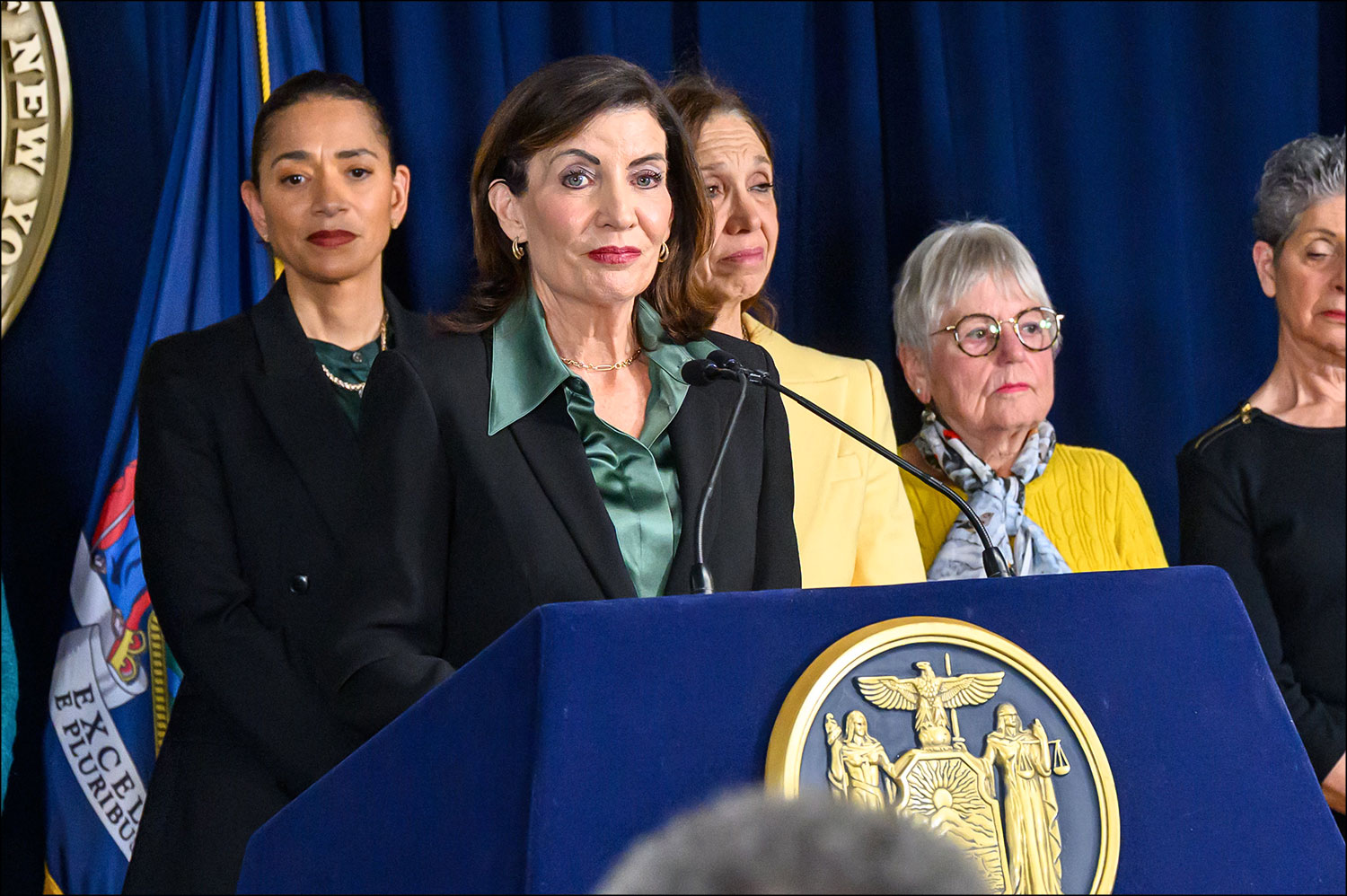
Terminally ill patients now have the option to receive medical aid in dying, or euthanasia, in New York State, after Gov. Kathy Hochul signed the Medical Aid in Dying Act into law early this month.
“This journey was deeply personal for me,” the governor said in a press release. Her mother died from amyotrophic lateral sclerosis, also known as Lou Gehrig’s disease, in 2014. “Witnessing my mother’s suffering from A.L.S. was an excruciating experience, knowing there was nothing I could do to alleviate the pain of someone I loved.”
In the Northeast, Vermont, Maine, New Jersey, Delaware, and Washington, D.C., already have similar legislation on their books, while Pennsylvania and Massachusetts have pending legislation.
Many so-called “guardrails” were written into the law to prevent abuse.
These included a five-day waiting period between when a prescription is written and when it is filled, a mandatory mental health evaluation of the patient by a psychologist or psychiatrist, a recorded oral request by the patient, and a prohibition against anyone who may financially benefit from the death of the patient from being eligible to serve as a witness to the oral request or act as interpreter for the patient.
Mary Crosby, the president and C.E.O. of East End Hospice, said her organization supports patient autonomy, but on the state level wouldn’t take a position on the Medical Aid in Dying Act. She thinks the way the law was presented sets up a false dichotomy.
“The announcement focused on how this would allow people to die with the sun on their face surrounded by loved ones at home, instead of in a hospital,” she said. “Everyone in hospice couldn’t believe it, because that’s what we’ve been doing for 60 years.”
“We were disappointed in the way the governor rolled out this legislation,” she continued. “We hoped there would be a mandate to first refer these patients to hospice. I think this will be hard on families.” Hospice provides bereavement and grief care, but those services were not mentioned in the law. “For patients who decide to use MAID, we think their families will need counseling more than other families,” Ms. Crosby said.
“New York State ranks last in terms of hospice utilization in the entire country. These two things cannot be spoken about without each other, MAID and hospice,” said Ms. Crosby. “Here, in New York, people tend to elect interventions and treatments until the very end, and that makes us stand out.”
The process for hospice intervention and Medical Aid in Dying referral is similar. A physician must certify that a patient has less than six months to live. Turns out, many wait much longer and late referrals are common. Over half of patients are in hospice for less than seven days.
“If you have a serious illness and no longer want to seek treatment, you’re probably ready for hospice,” said Ms. Crosby. Of course, it’s difficult to know exactly how long someone has left. If someone goes on hospice and doesn’t die within six months, it’s not like they’re tossed off, however. They can be recertified.
Ms. Crosby said her organization will support anyone who wants to take advantage of the Medical Aid in Dying Act, but her staff would not provide end-of-life medications themselves.
The law also allows “religiously oriented” home hospice providers to opt out of offering medical aid in dying. Ms. Crosby said her staff “runs the gamut” on whether MAID is against their ethical standards.
“We support patient autonomy but a fundamental part of that is we do nothing to hasten death,” she said. “We’re here to help families create best moments in a bad situation.”
Local religious organizations did not respond to The Star’s request for comment on the new law. However, the Catholic Church, in particular, has been steadfastly against the practice for about 2,000 years.
“Intentional euthanasia, whatever its forms or motives, is murder,” reads the Catechism of the Catholic Church (CCC 2324). “It is gravely contrary to the dignity of the human person and to the respect due to the living God, his Creator.”
Many believe death is part of life, no matter what that looks like. The American Medical Association is also against the practice. Its code of medical ethics is clear on the matter:
“Euthanasia is fundamentally incompatible with the physician’s role as healer, would be difficult or impossible to control, and would pose serious societal risks,” reads the code. “Euthanasia could readily be extended to incompetent patients and other vulnerable populations.”
Ms. Crosby said the attraction of MAID is the semblance of some sort of control over a usually uncontrollable situation.
“What does it mean to be dying? We think of every patient as living until they’re dead. If people are afraid of anxiety, pain, or shortness of breath, hospice can help manage those symptoms. One thing we can’t control is the loss of autonomy, which is the number-one reason people choose MAID,” she said.
In conversations with providers in other states, Ms. Crosby, who also sits on the Board of Hospice and Palliative Care Association of New York, said “Many patients get end-of-life medications and never use them.”
“People don’t want to be bedbound, or feel they’re out of control, but it’s a natural part of life. There are beautiful moments that happen in the very end when people are barely conscious. In countries where they haven’t highly medicalized death, people tend to die in their homes with their family.”
Is there a “right way to die?” Laws will come and go, but that question will remain.
“Our state will always stand firm in safeguarding New Yorkers’ freedoms and right to bodily autonomy, which includes the right for the terminally ill to peacefully and comfortably end their lives with dignity and compassion,” Governor Hochul said. “New Yorkers deserve the choice to endure less suffering, not by shortening their lives, but by shortening their deaths — I firmly believe we made the right decision.”


