
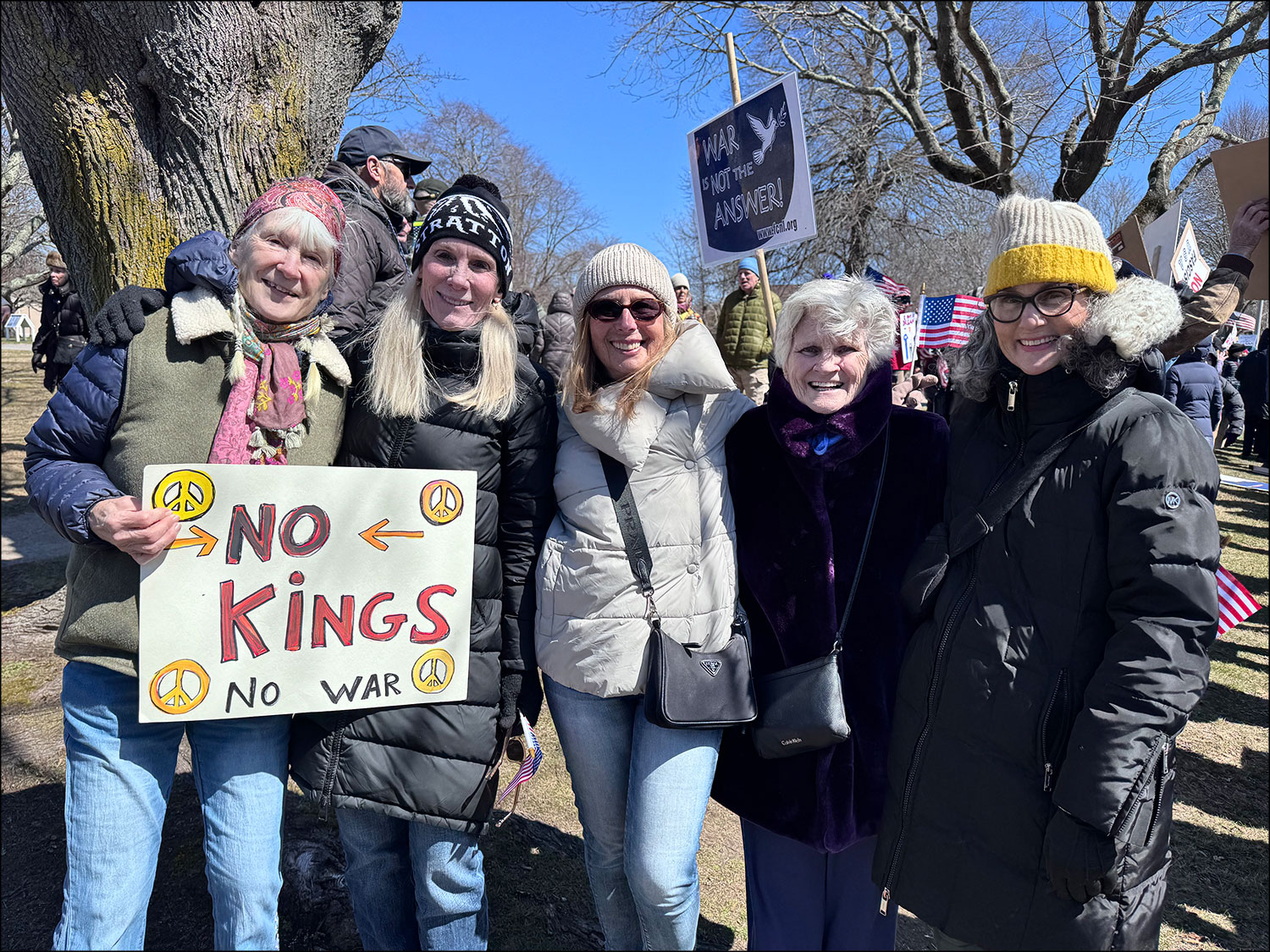
The March 28 No Kings rally at East Hampton Town Hall was not the largest of the three such events held there in the last year, but as one of some 3,300 actions across the United States and around the world, it was part of what may be the largest single-day protest in the nation’s history.
The cold of the early spring day — the temperature hovered under 40 degrees through the late morning and early afternoon — may have depressed turnout, along with concern about visibly and vocally opposing the Trump administration during its continued efforts to detain and deport undocumented immigrants and stifle dissent. But some 1,200 did come out, according to a Police Department estimate, and with a war in Iran and continuing rage at federal Immigration and Customs Enforcement actions in cities and towns around the country, they were not at a loss for words.
No Kings rallies also took place in Sag Harbor, Southampton, Greenport, and Riverhead on March 28, each adding to estimates of eight to nine million participants in total.

The East Hampton rally was dedicated to Barbara Burnside, a Springs resident and organizer of the first protest of the second Trump administration at Town Hall who died in January. It was “a way of standing up to chaos and cruelty, unconstitutional actions too numerous to go through,” Katherine Stahl, an organizer, told the crowd gathered behind Town Hall. “These events are an opportunity for us to come together as one and to say we the people object, strongly object.”

“People died to allow us to vote,” continued Ms. Stahl, of People for Democracy East Hampton, a chapter of the Indivisible movement. The founders envisioned that “there would come a time when we needed to vote out the people that were not following the law,” she said. “And our opportunity to vote is threatened this year and may be threatened for the next election as well. It is a serious threat to our free and fair elections that is being posed.” She urged participants to “make sure that we do all we can to get more people to vote,” noting that “the numbers of people in the United States that don’t choose to vote is astonishing,” particularly among younger people. Councilwoman Cate Rogers read from Thomas Paine’s “The American Crisis,” essays from the Revolutionary War era, and the 1878 Decoration Day address by Frederick Douglass. Quoting from the latter, she said, “The American people will, in any great emergency, be true to themselves. The heart of the nation is still sound and strong, and as in the past, so in the future, patriotic millions, with able captains to lead them, will stand as a wall of fire around the republic, and in the end see liberty, equality, and justice triumphant.”
“We are those patriotic millions,” Ms. Rogers told the assembled, moments before the rally moved to Pantigo Road. “We are that wall of fire and we are here today. No kings then. No kings now. No kings ever!”
Music filled the air, both before and after the remarks delivered behind Town Hall, as those gathering for the rally sang popular songs of resistance, including “Blowin’ in the Wind,” “This Land Is Your Land,” and “We Are Not Afraid,” led by Emily Weitz and Adelaide Mestre, of Sag Harbor, and Francine Whitney of Springs. Organizers said this new element of the local No Kings events was inspired by citizens’ resistance to ICE operations in Minneapolis, where agents shot and killed two American citizens in separate incidents in January.
As the assembled lined Pantigo Road holding signs with messages like “I’m Mad as Hell,” “Fair Elections,” “Stop Trump,” and “No War, No ICE, No Trump,” passing vehicles sounded their horns, creating a cacophonous backdrop to an atmosphere that was at once festive and somber.
“I’m here to defend democracy and to end the tyranny of murders of American citizens by ICE, and to stop tormenting and brutalizing immigrants,” Helen Mendes of Springs said. “This is our First Amendment right to protest and to end this horror now.” The president, she said, “is disgracing us on the world stage, he’s bankrupting people, and it is all for his grift. He’s a con man.”
Asked why she was protesting, Maggie Kirwin of Water Mill answered with a question: “Where to begin?” The war against Iran, she said, “is destroying the whole world. It’s not just Israel and the U.S., it’s the entire world. We’re going to go into a great depression, no doubt about it.”

Her daughter, Claire Hunter of Water Mill, held a sign depicting herself as a child, protesting the American invasion of Iraq in 2003. “I hate that this country has become unrecognizable,” she said. “It’s heartbreaking to me what’s happening . . . every level of it is appalling.” Dressed as Uncle Sam and riding a three-wheeled cycle bearing signs including the message “Defend human rights for all immigrants,” Paul McIsaac said that “Uncle Sam is here because he’s been here forever defending democracy.” One-third of the country, he said, “has gone completely insane. . . . They’re following someone,” he said in reference to the president, “who is clearly an infantile personality, a narcissist who keeps doing things that could end life on earth, actually. What he’s done in terms of the climate is just horrendous.”
Mr. Trump, said Ms. Mendes, “is seeking to destroy us, and we won’t let him. We’re Americans.”
Last week's nationwide action will soon be followed by another: A coalition of groups including Indivisible have announced a nationwide general strike on May 1. The groups are urging the public to stay out of school and work and to refrain from shopping on that day. Their demands, said Neidi Dominguez, executive director of Organized Power in Numbers, include taxing billionaires, an end to ICE and to the war in Iran, “and no private army for authoritarian power.”
As of Wednesday, it was not known if an organized day of action will be planned in the town.


