
The Sag Harbor Village Planning Board dealt a blow to Adam Potter’s plan to redevelop several lots on Bridge Street last week when it denied a request to review two of the components of the project separately.
Mr. Potter, the owner of the lots at 5, 7, and 11 Bridge Street, had presented the several-years-old plan to the planning board in May 2025, when a public hearing drew a sizable crowd of people opposed to the mixed-use building.
Of the three-story, 81,000-square-foot building at 7 and 11 Bridge Street, around 50,000 square feet would be devoted to housing. Mr. Potter is planning 48 units he could sell at market price and 28 affordable units. On the first floor, 8,500 square feet would be set aside for service-use commercial space.
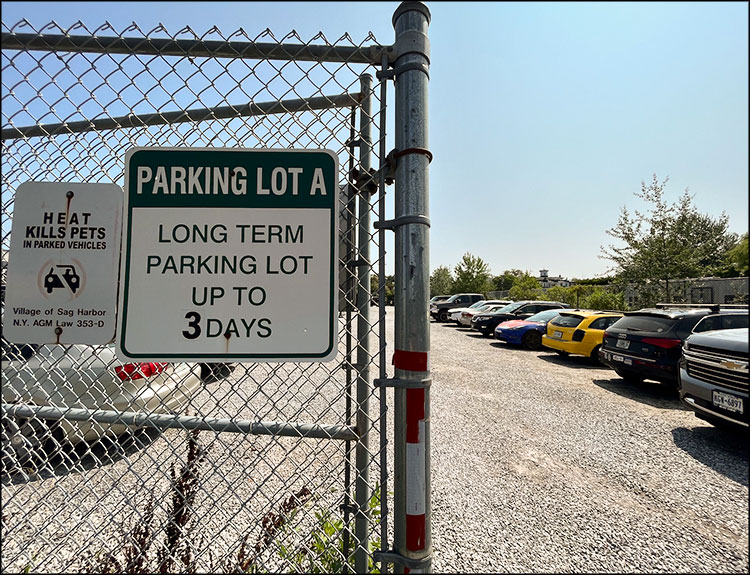
He plans 44 parking spaces at 5 Bridge Street, known as the “gas ball” lot, which is now being leased to the town for municipal parking. That lease is set to expire in 2027.
All of the components of the project would have to be reviewed under the State Environmental Quality Review Act (SEQRA), a time-consuming process wherein a village consultant reviews the plans and determines the environmental, social, and economic impacts of the project.
As it stands, there is extensive coal-tar pollution on the properties. Mr. Potter said that pollution was always known to exist on the gas ball lot but had spread to the other sites.
That review is what Mr. Potter and his lawyer, Tiffany Scarlato, came to the board to discuss.
The planning board had been in the process of completing the final environmental impact statement on the properties but paused the review several months ago, according to Mr. Potter. That review, once completed, could then be voted on by the board to move the process forward.
But board members said that without a formal remediation plan for the coal tar in place, they would not vote on accepting the review. The State Department of Environmental Conservation and the Suffolk County Department of Health are working with Mr. Potter and the village to finalize the remediation plan. Work to remove and contain the pollution could begin as soon as the end of the summer, Mr. Potter said.
The slowdown on the review of the gas ball lot — a lot that would provide parking only for the proposed building — is in turn slowing down review of the lots that would contain the apartment units. And while those lots — numbers 7 and 11 — do contain some contamination, they are not as heavily polluted.
Mr. Potter’s position was that by separating the SEQRA review of the gas ball lot from numbers 7 and 11 Bridge Street, the more in-depth environmental review would be reserved for the more contaminated site and would not hold up the review of the remaining two lots and the building planned there.
Splitting the review — known as segmentation — is “something you should avoid except in very special cases,” said John Ellsworth, a consultant from the engineering firm Nelson Pope Voorhis, which was hired by the village.
But Ms. Scarlato told the board the application is “one of the best segmentation applications that has ever been.” She argued that the planning board, which has lead-agency status (meaning that it takes the lead in reviewing the project), is not reviewing the gas ball lot, but the other two lots, and that the parking that is to be located on the gas ball lot is mitigation offered to the village for the construction.
If the parking lot were part of the application to the planning board, she went on to say, a use variance to allow for stand-alone parking would not be required at all, since the combined lots would contain a structure — which is required by law.
Ms. Scarlato said Mr. Potter will not be renewing a lease with the village for parking at 5 Bridge Street when the lease expires next year. At that point, “there is a parking lot with no utility,” she said.
That triggers the need for a use variance from the zoning board of appeals, which reviewed the request in March. Barring approval of the use variance, Ms. Scarlato has also asked the Z.B.A. to overturn a building inspector’s determination stating that the parking lot use could not continue without a structure on the lot.
Mr. Ellsworth noted that while the planning board may not be reviewing the gas ball lot, the “parking at Bridge Street is an integral part of the application,” and that by approving the segmentation, decisions in the future “may be subject to legal challenge.”
Some board members questioned the timing of the segmentation application, saying it might be too soon to apply since the lease with the village doesn’t expire until next year.
Drew Harvey, a board member, suggested Ms. Scarlato withdraw the application, which she said she was unwilling to do.
Elizabeth Vail, the board’s attorney, said that since the Z.B.A. is actively reviewing the application, the planning board application was appropriate.
With the exception of Susan Hewitt, a board member who sat out of the discussion, the board voted unanimously to deny the request.
The proposal requires several approvals from the planning board, including a special exception approval to allow apartments in the office district and to build a structure larger than 3,500 square feet in the waterfront overlay district.


