
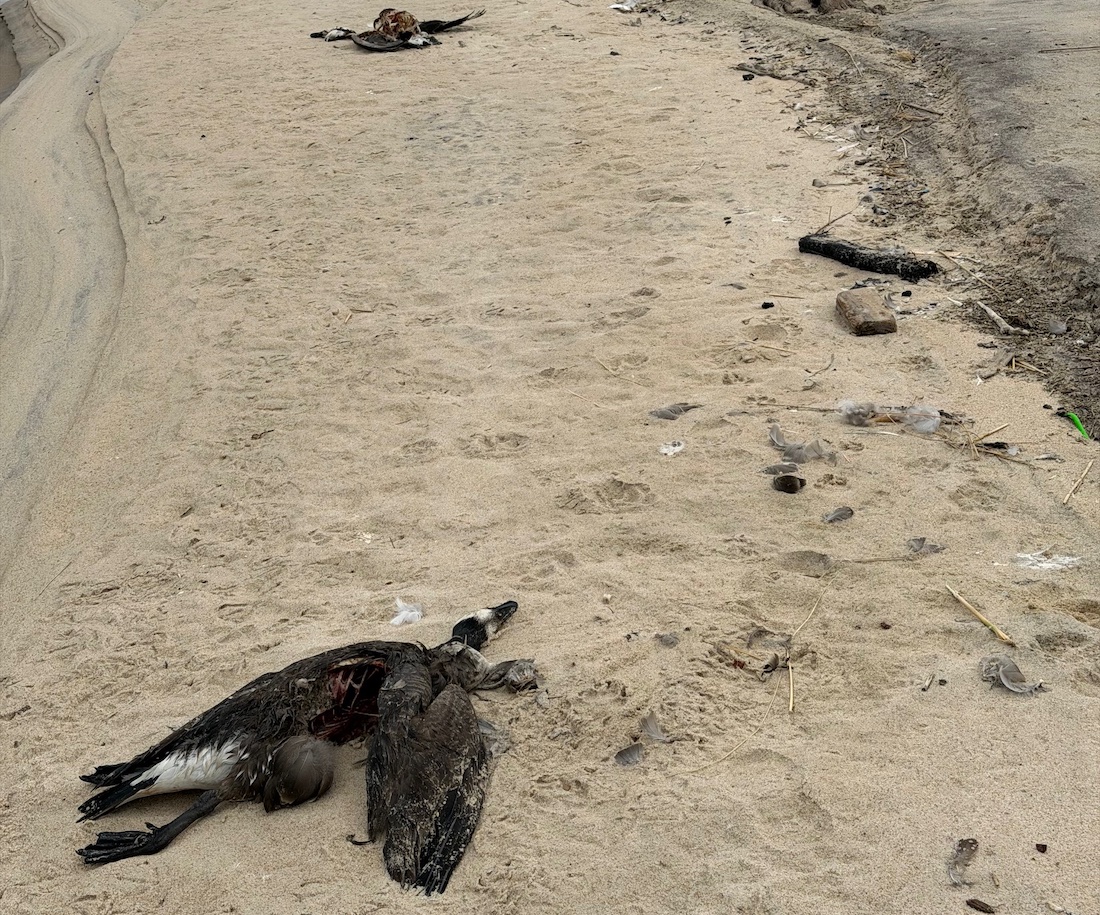
Reports of dead Canada geese in great numbers along the ocean beaches in the waning days of February have announced the arrival here of what appears to be a wave of avian influenza, posing a threat not only to wild birds and domestic poultry but also to pets that “go outside and eat or are exposed to sick or dead birds or other animals infected with avian influenza viruses,” according to the Centers for Disease Control.
The reports — both eyewitness accounts from Star staff and photographs sent in by concerned readers — come on the heels of the recent necropsy performed on a snowy owl found at Louse Point, that concluded it had died from the so-called “bird flu.”
While people are becoming inured to encounters with dead birds, it is still shocking to come across dozens of carcasses.
John Sabasteanski decided to take a walk on the beach near Wainscott Pond last weekend with his daughter Nika. “As we approached the pond, she asked what the objects were that were strewn about on the beach and as we got a bit closer, we identified them as birds, assumed this was related to bird flu, and entered a mild state of panic mixed with jokes about how this could be the opening scene of a horror movie,” he wrote in a text. “There were roughly 40 birds dead on the beach between the pond and the ocean.”
He reported another 20 between the pond and the parking lot and contacted the New York State Department of Environmental Conservation.
“It does seem to be devastating the geese around here right now,” Dr. Jonathan Turetsky, a veterinarian at the Veterinary Clinic of East Hampton, said on Tuesday. “We are seeing a massive die-off. It can affect any bird but is most prevalent in waterfowl.”
He added that three sick geese had entered his practice just in the last 24 hours.
A New York State Ornithological Association waterfowl count conducted in January showed that Canada geese are by far the most numerous waterfowl on the East End in the winter.
On Friday, the Friends of Georgica Pond emailed its members to inform them “that a large number of dead geese have recently been discovered at Georgica Pond” in East Hampton. “The incident has been reported to the New York State Department of Environmental Conservation and appropriate health authorities. While the specific cause has not yet been confirmed, highly pathogenic avian influenza . . . is currently present across New York State and is a possible cause.” Walkers who visited the pond on Saturday counted as many as 40 geese carcasses there.
Last week, dozens of dead geese were seen by Star staff on the beach between Town Line Road and the Georgica Gut.
The widespread destruction is not just limited to Canada geese.
Grace DeNatale, the hospital supervisor at the Evelyn Alexander Wildlife Refuge in Hampton Bays, said she has also confirmed H.P.A.I. in bufflehead, hooded merganser, and snow geese, just in February. She said the D.E.C. has been hit with so many requests to test geese that the center was informed that the state agency would no longer pick them up. The center has euthanized over two dozen geese with suspected H.P.A.I.in the last month.
Cases of highly pathogenic avian influenza have recurred in New York State, and in neighboring states, since 2022, but this is the first apparent largescale outbreak recorded on the South Fork in several years. In 2022, the Spring Farm in Sag Harbor had to euthanize some 6,000 game birds after avian flu was discovered there.
“This winter was cold and a lot of our waterfowl were frozen out of their optimal environments and often smushed into closer quarters,” Ms. DeNatale said. “Their immune function was already compromised because there has been less food for them to eat with all the snow cover. It’s just been a perfect storm for a really bad winter to spread flu,” she said.
Last year the center had a fox test positive as well. “Keep your dogs off of dead things, and keeping them leashed is very important,” she said.
News reports indicate that a large wave of the virus may be moving northward from Pennsylvania, where millions of birds have died this year. According to a report that aired on Saturday on WHYY, a public radio station in Philadelphia, “Pennsylvania officials addressed growing concerns about avian flu, as the U.S. Department of Agriculture reported over seven million birds have been infected with the highly contagious virus in the state in the past 30 days.”
Also on Saturday, The Vineyard Gazette on Martha’s Vineyard reported that Massachusetts had recorded an outbreak in a backyard chicken flock, with “five chickens and three nearby geese” testing positive on Feb. 20.
The virus can travel when raptors, such as owls and hawks, feed on carcasses. Songbirds do not appear to be highly susceptible to infection.
“I have never seen a songbird infected with the flu, ever,” said Ms. DeNatale. “I’m not recommending that people stop feeding birds. That said, I would recommend that people disinfect their feeders weekly.”
Dr. Turetsky echoed Ms. DeNatale’s sentiments. “We’ve talked over the years whether with bird flu spreading if people should use bird feeders. The consensus is that it’s okay if you keep them clean.”
Incidents of transference to humans are low. But according to the announcement from Friends of Georgica Pond, the C.D.C. recommends keeping “children and pets away from affected areas, including the shoreline and pond water, until further notice, and preventing domestic animals from coming into contact with sick or dead wildlife.”
The C.D.C. says that avian influenza viruses “mainly infect and spread among wild birds and domestic poultry,” but that “some avian influenza viruses can infect and spread to other animals, including pets. . . . While it is unlikely that you would get sick with bird flu from direct contact with your infected pet, it is possible.”
Unfortunately, there is not much that can be done to help the birds. “Clean up and support your ecosystem in general,” offered Ms. DeNatale. “Maybe if our environment were a little healthier and better suited to our wild neighbors, they wouldn’t be in such a rough place.”
Dr. Turetsky said there “was no silver lining” to be found with the outbreak, but said that as with the human flu virus, the season would pass.
With Reporting by Bess Rattray


