
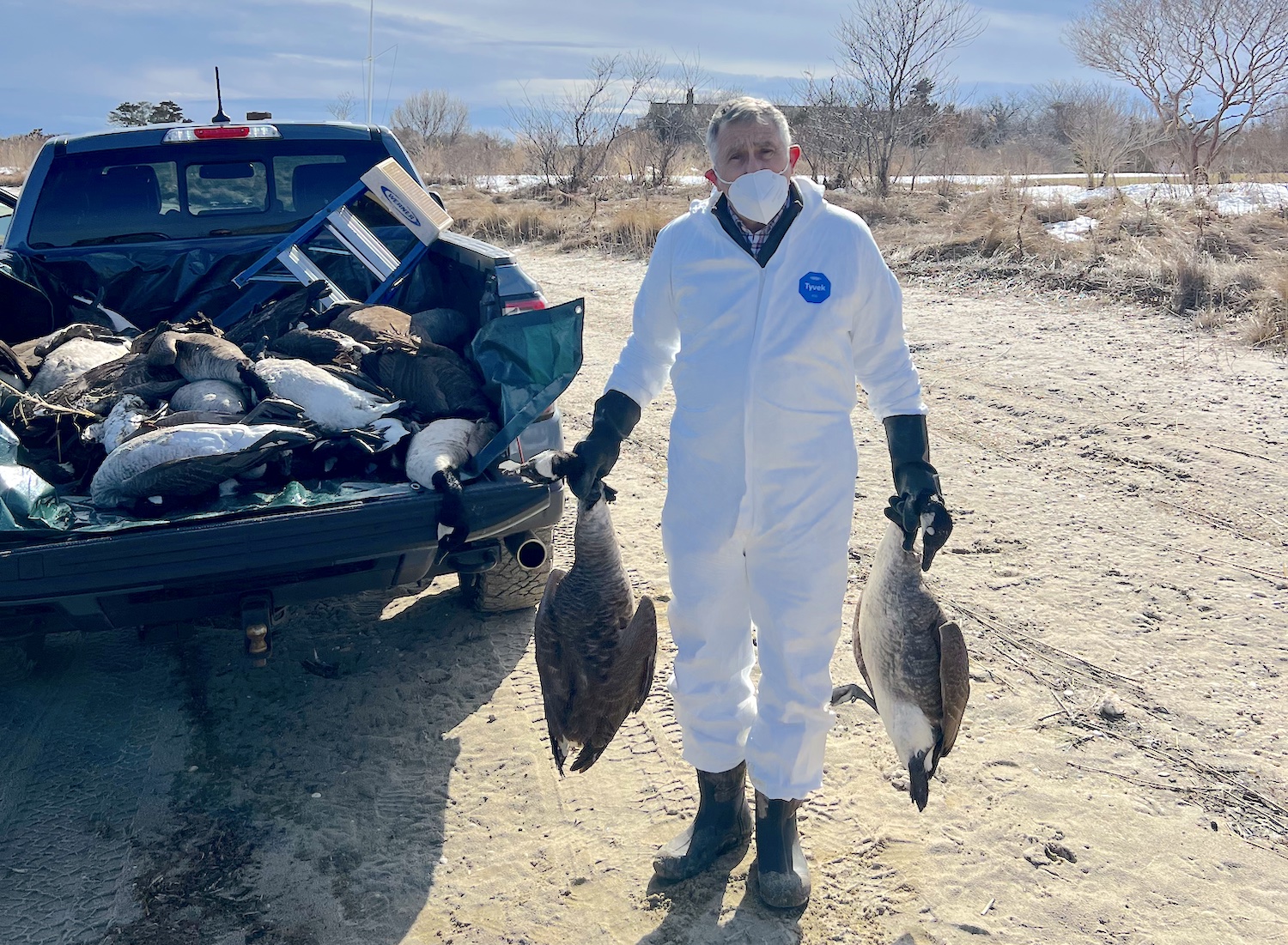
Approximately 600 dead Canada geese, likely victims of avian flu, were removed from around Georgica Pond late last week and buried in the sand, Jim Grimes, an East Hampton Town trustee, said Friday afternoon.
“I had 230 geese on Wednesday, on the west side of the pond. Pat Bistrian is down there dredging Georgica Pond, and he helped me out by digging a trench. Today I’ve collected another 316. I’m now headed over to the east side of the cut where I’m told there’s another 75 to 100 birds,” Mr. Grimes said. He wore a mask and protective suit as he worked.
As of Monday, that number edged closer to 700 but seemed to have stabilized.
Numbers were high, although not initially as high across the town line in Southampton, where potentially hundreds have been found in the thawing ice of Sagaponack Pond at Sagg Main Beach, according to Ryan Murphy, the public safety and emergency management administrator.
“That’s our biggest cluster yet,” he said in a text, adding that the town trustees’ marine maintenance unit would address the situation and that the New York State Department of Environmental Conservation would be looped in. “Our marine maintenance division disposed of 30 to 40 who died at Long Pond in Sayre Park recently,” he added.
Mr. Murphy said that fortunately, he hadn’t heard of any mass die-offs on the town’s agricultural lands, a point that was corroborated by Kate Perz, the 4-H animal science program coordinator with the Suffolk County Cornell Cooperative Extension.

“At this time, there have been no reported positive cases in backyard flocks [of chickens] on Long Island,” she wrote in an email. Ms. Perz added that the United States Department of Agriculture bird flu detection website reported only three cases at live bird markets in Kings and Queens Counties within the last 10 days.
“We strongly recommend that chicken owners continue to practice good biosecurity measures to help protect their flocks and report any chickens showing avian influenza symptoms to the New York State Department of Ag and Market’s Division of Animal Industry at 518-457-3502,” she added.
It has been a terrible winter for wild birds.
Fields where geese feed have been covered in inches of snow since late January, creating food scarcity and potentially impacting their immune function. Then the uncommonly harsh cold of February froze many of the ponds where they roost at night, which pushed the birds more tightly together into the few areas that were not frozen. When highly pathogenic avian influenza, also called bird flu, hit, it tore through the flocks.
Geese aren’t the only birds impacted by the flu. Other waterfowl, such as ducks, loons, swans, and cormorants have died from it as well. However, Canada geese are by far our most densely populated winter waterfowl and have in recent weeks been the most visible victims of the virus.
The D.E.C. said that it is no longer coming out to pick up and test the carcasses, but it did offer some potentially good news, according to Mr. Grimes. As temperatures climb and the ponds lose more ice, there will be more habitat for the birds, and the D.E.C. expects the outbreak to abate.
“As the weather warms up, these things are really going to start to reek,” Mr. Grimes said Friday. “We should have most everything cleaned up today, but there are sick birds still out there, and there will be more dying in the coming days and weeks.”
“It doesn’t seem like there is greater mortality in geese versus other species,” Andrew Farnsworth, a migration ecologist with the Cornell Lab of Ornithology, said by phone Friday.
The worldwide population of Canada geese is north of five million, according to Mr. Farnsworth, who said he expects our local population to bounce back. While many bird species have seen massive population declines in the last 50 years, with estimates of one in four gone forever, the numbers of Canada geese have increased.
With the local die-off, he said there would be fewer birds occupying the same habitat and resources that once served a larger flock will become more plentiful. In the short term, this could lead to larger brood sizes until the population regulates back to a normal level.

“Canada geese are very good at responding to humans, but not all birds are,” he said. “They tolerate us and take advantage of the wastelands we create. However, just because Canada geese are common now does not mean it’s always going to be that way. No population is safe.”
It is rare for animals to transfer bird flu to humans; nonetheless, the Centers for Disease Control recommends keeping children and pets away from affected areas.
This article has been updated since it first appeared online.


