
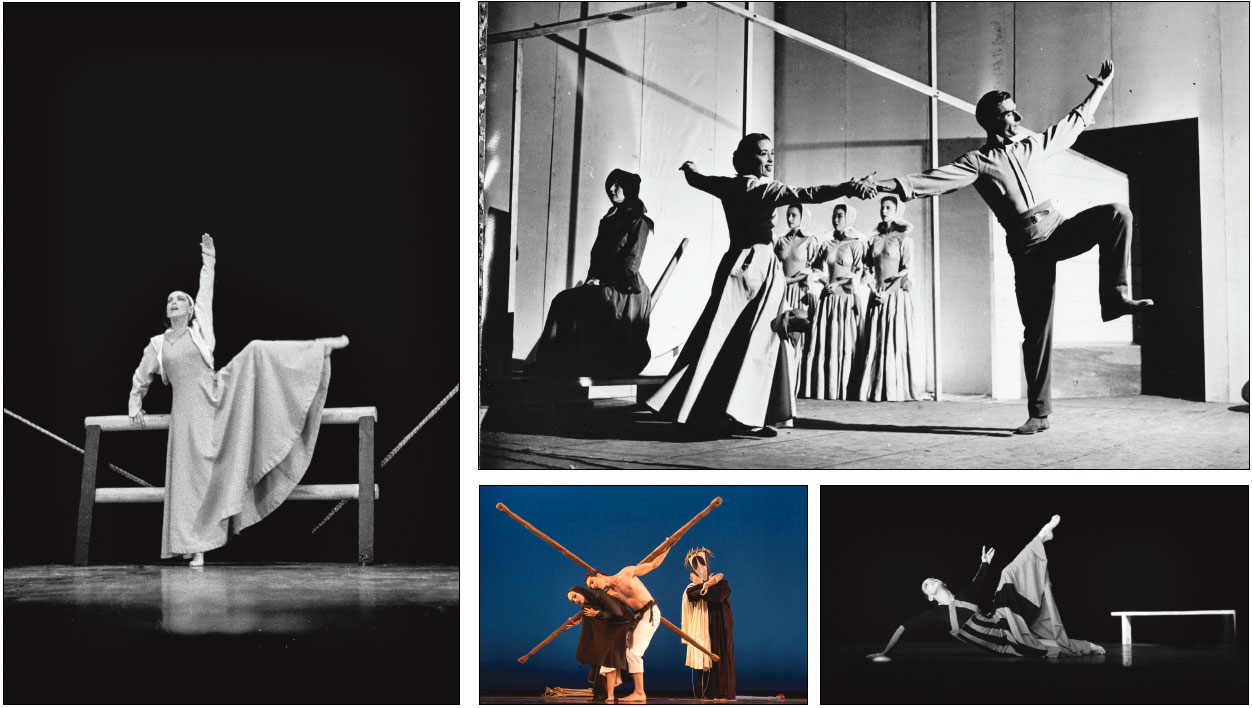
In February 2021, shortly before The Church in Sag Harbor opened to the public for the first time, two choreographers and three dancers from the Martha Graham Dance Company became its first resident artists. While they developed a project inspired by a 1952 work by Graham, because of the pandemic it could only be seen by live-streaming.
After Sheri Pasquarella became the venue’s executive director, Eric Fischl, its co-founder, asked her if she had any interest in bringing them back. “I thought about the idea,” she said during a conversation at The Church. “Eric introduced me to Janet Eilber, who is the artistic director of the Martha Graham Dance Company. Janet told me that 2026 would be the 100th anniversary of the company, and I started thinking that beyond doing a performance, what would be more impactful for our community would be to explore dance as an exhibition.”
“Martha Graham: Collaborations,” which will open Saturday with a free reception from 6 to 7:30 p.m., is the fulfillment of Ms. Pasquarella’s idea that the choreographer’s collaborations would form the core of the exhibition, because over the course of Graham’s career she worked with so many innovative artists, designers, and musicians.
“While I had the concept, by no means would this ever be a thing I could curate myself,” said Ms. Pasquarella. “It’s important that The Church be a platform for a multitude of voices.” Ms. Eilber suggested Oliver Tobin, whose history included being a dancer with the company for 10 years and director of Martha Graham Resources, the company’s archive that now resides at the New York Public Library for the Performing Arts.
“After Janet introduced me to Oliver, his passion and knowledge and vision for this show shone through really quickly. He has been amazing to work with on a personal level, but also the depth of knowledge and his experience as a dancer inform so much of the exhibition.”
Born in 1894, Graham founded her eponymous dance company in 1926 and over the next 65 years, until her death in 1991, she choreographed 181 ballets. One of her most frequent collaborators was the sculptor Isamu Noguchi, who designed 18 sets for her company between 1930 and 1988.
One of those was the set for “Frontier,” a solo dance performed by Graham that premiered in 1935. Noguchi’s set consisted of a rough log fence, two rails supported by two upright posts at center stage, and two lengths of rope that stretched in a V shape from either wing of the stage to a point below the fence.
On entering the main floor of The Church, visitors will see curatorial statements and the timeline that runs from Graham’s birth to her career from about 1918 to 1926. Straight ahead, Noguchi’s set for “Frontier” will be installed in front of the elevator at the far end of the room, and a film of Graham performing that ballet will be projected above the set on the elevator. Three more of Noguchi’s sets will be installed on the mezzanine level.
Two other important collaborators were the composer Aaron Copland and Jean Rosenthal, an influential lighting designer who developed what is known as Rosenthal Blue, which is now ubiquitous in dance performances with blue lighting. An installation in a corner of the mezzanine is a space surrounded by draperies that Ms. Pasquarella compared to “a sound bath room. The lighting will be Rosenthal Blue, and Copland’s ‘Appalachian Spring’ will be playing. On the wall will be vinyl and a timer that guides you through reading the segments as Martha is describing her vision of the piece as it plays. Blue with white spotlights will illuminate each text as it comes up.”
As for costumes, while Graham designed some herself, other noted collaborators have included Donna Karan, Halston, and Calvin Klein. One of Graham’s costumes, for the 1930 ballet “Lamentation,” features Graham in a loose purple tube-like garment from which only her head, hands, and feet protrude.
During a phone conversation, Ms. Karan told Mr. Tobin that Graham’s design for “Lamentation” influenced her entire design vocabulary. One of Ms. Karan’s designs for Graham is included in the exhibition, as is one by Halston, who was also influenced by Graham’s costumes. Citing Halston’s simple wrap dresses, Ms. Pasquarella said, “It’s the same idea, where the body gives the form to the garment, and not vice versa.”
During the installation, a visitor saw that shapeless “purple tube-like garment” as well as photographs of it in use. Mr. Tobin and the installation team were in the process of figuring out how to install the costumes, which operate by tension when inhabited by a dancer, but not so much by a mannequin.
Ms. Pasquarella was drawn to the theme of collaboration, “because one of the magical things for the audience with dance is the net result. Yet it is an art form that requires an enormous amount of diversified artists of varied disciplines to execute the final work,” including costume designers, lighting designers, stage designers, and musicians. “I think that can be very elusive to audiences because of the magic we get caught up in when we’re sitting in the audience.”
Among the other collaborators not previously named were John Houseman, the actor and director, and the renowned composers Louis Horst, Samuel Barber, William Schuman, Carlos Suriñach, Norman Dello Joio, and Gian Carlo Menotti. Graham’s company was the training ground for many future modern choreographers, including Merce Cunningham, Paul Taylor, and Twyla Tharp.
Graham also created roles for such classical ballet stars as Margot Fonteyn, Rudolf Nureyev, and Mikhail Baryshnikov, inviting them as guests into her company. While in charge of movement and dance at the Neighborhood Playhouse, she taught actors including Bette Davis, Kirk Douglas, Madonna, Liza Minnelli, Gregory Peck, Tony Randall, Anne Jackson, and Joanne Woodward how to use the body as an expressive instrument.
Other components of the installation will include photographs and videos highlighting the collaborations, a large monitor featuring a series of interviews with dancers, scrolls with the names of all the dancers who have performed with the company, and a film of Graham and the full company in collaboration on a dance, projected on a piece of suspended tulle.
“It has been such an amazing experience to work on this, and every time I think I’ve got Graham and this whole thing figured out for myself another curveball comes in and I learn so much more,” Mr. Tobin said. “I was fortunate enough to swing from a lot of different monkey bars in the Graham canon, from being a dance student at the school, dancing in the second company, dancing in the main company, serving as an educator for the school, and then directing the archives for a number of years.”
Regarding the installation, he said, “When we’re dancing in an opera house or the Joyce Theater or outdoors or in a gallery or non-dance-built environment space, we really respond to the space. This show has also been designed with The Church’s space in mind, which is why ‘Frontier’ is centered and then extending up into the space. It’s symbolic but it’s also utilizing this incredible architecture and structure.”
The exhibition will continue through March 22.


