
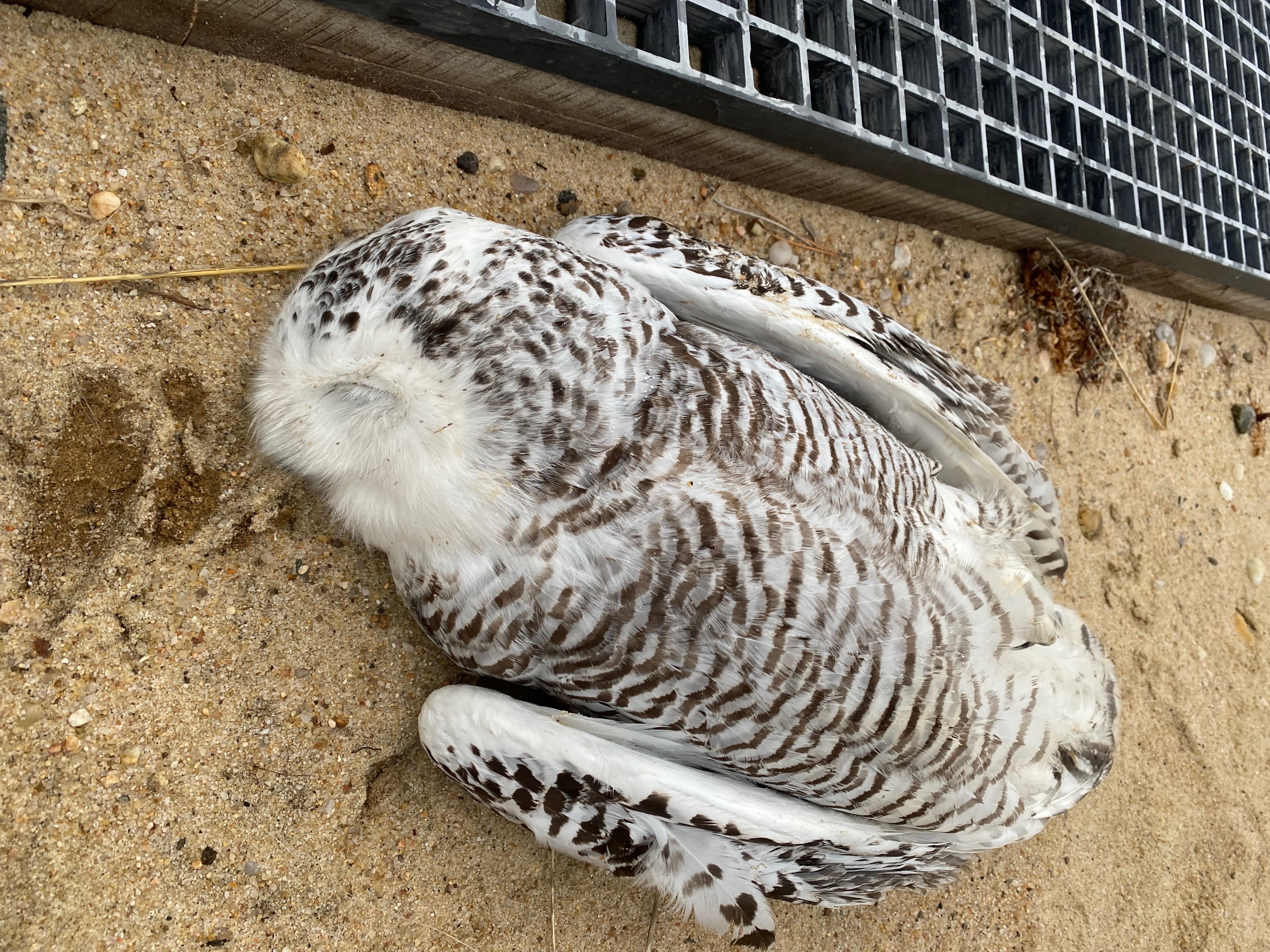
A dead snowy owl found by Glyn Vincent and his wife, Stacy Goodman, as they strolled near Louse Point in Springs on Jan. 17 died of bird flu, or highly pathogenic avian influenza, the New York State Department of Environmental Conservation confirmed last week.
There is no way to contain that strain of influenza in wild birds, according to the D.E.C. It was first documented in the state in 2022.
“H.P.A.I. continues to infect birds and mammals across the U.S. and Canada,” the agency said in a statement. “H.P.A.I. is carried by free-flying waterfowl and other waterbirds, such as ducks, geese, and shorebirds, but can also infect domestic poultry, raptors, corvids [such as crows and blue jays], and mammals. D.E.C.’s Wildlife Health Program is monitoring the spread and impact of H.P.A.I. throughout the state and has an online reporting tool the public can use to report suspected H.P.A.I. mortalities: NYSDEC Avian Influenza Reporting Form.”
In November and December, the D.E.C. received 69 reports of suspected mortalities through the portal. February marks the busy period for duck and geese migration, and it is expected that the incidence of H.P.A.I. will remain high through spring.
According to anecdotal local reports and posts to Instagram and Facebook about sick geese, there are likely hundreds of birds, if not more, that have succumbed to bird flu this winter.
“It’s a perfect lookout point,” Mr. Vincent said, describing the area where the owl was found. “I saw a bundle of feathers on the ground and at first thought I was looking at a dead gull. As I got closer, it became obvious it was something else. It was lying on its back, and I saw its really sharp black talons. Then I found its face, hard to see, all cuddled in feathers, and realized it was a snowy owl.”
Mr. Vincent said the owl showed no obvious signs of distress.
While bird flu killed the owl, many raptors, such as owls and hawks, are also killed when they eat rats and mice poisoned by rodenticide. A 2022 study published in the journal Ecotoxicology found that 68 percent of red-tailed hawks had the poison in their systems.
Snowy owls can be found on the beaches here in the winter, with population levels varying year to year. Project SNOWstorm, a nonprofit that studies the movement of snowy owls, reports that owls that overwinter on beach areas frequented by humans move around much more than owls in remote marsh areas. Owls tend to get flushed inadvertently by people and off-leash dogs, but also sometimes purposefully by aggressive photographers trying to get pictures of them in flight.
Such apparently was not the case for the Louse Point snowy owl found by Mr. Vincent. The owl had not been reported to eBird, and in fact had been left undisturbed for another day before he could return with Mike Bottini, a wildlife biologist with the Seatuck Environmental Association, who handed it off to the D.E.C. for testing.
“The public should strongly consider that groups of birds found deceased are H.P.A.I.-positive and should follow [Centers for Disease Control] safety protocols to reduce contact,” the D.E.C. said in the statement, adding a recommendation that the public avoid any contact with sick or dead birds and mammals.
“H.P.A.I.-infected birds may be asymptomatic or may exhibit signs of respiratory distress, lethargy, neurologic malfunction (ataxia, stargazing, or seizures), diarrhea, weakness, or sudden death.”
The D.E.C. is particularly interested in suspected outbreaks in all waterfowl, raptors, crows, shorebirds and gulls, loons and herons. Songbirds do not appear to be highly susceptible to infection.
Jane Gill, a real estate agent and volunteer for the Quogue Wildlife Refuge, has seen a lot of bird flu in clusters of Canada geese and double-crested cormorants this year. “I see geese that are lethargic and walking in circles. When you get close, you see their eyes aren’t clear,” she said. “Many people don’t know. Dogs that are off-leash may sniff at a dead bird and the virus can easily be transferred.”
Dogs with avian flu may show symptoms of fever, lethargy, coughing, nasal discharge, or neurologic signs. Dogs should be leashed at beaches and on trails to avoid exposure.
Compounding the issue for the geese this winter is that many ponds have been frozen, and the farm fields where they often feed are under a two-foot blanket of snow. So they are clustering tightly, perhaps spreading H.P.A.I. more efficiently.
Ms. Gill said a friend reported more than 20 dead geese in a field across from their house. Many of the dead geese, if left for a couple of days, get partially eaten by either raptors or raccoons, further spreading the illness.
“If you find a dead bird on your property, triple-bag it and put it in the garbage,” she said. “It’s a horrible thing to have to do, but it’s what we have to do.”
“While avian influenza continues to affect wildlife, the risk to humans remains low,” Dr. James McDonald, the New York State health commissioner, said in a statement. “New Yorkers can stay safe by avoiding contact with sick or dead birds and animals and reporting anything unusual.”
According to the D.E.C., in addition to wild birds, H.P.A.I. has also been confirmed in red foxes, skunks, possums, raccoons, fishers, gray squirrels, muskrats, and bobcats in the state, and in a wide range of mammals, particularly carnivores, in other parts of the U.S. In addition to domestic poultry, dairy cattle in other states have also been infected.
“Many people are genuinely concerned about birds,” Shai Mitra, an ornithologist and assistant professor at the College of Staten Island, said. “But they should understand that flu is just one of many things that wild animals face. It’s worth monitoring, just like climate and habitat, but there’s nothing we can do to ‘fix’ it.”


